Future-Proof Your Child: What Actually Matters More Than Career Prep
A few years ago, a client sat across from me, looking like she had tried to solve the entire global economy before lunch.
Her son was ten. Bright. Creative. Deeply uninterested in homework.
She had researched:
Fastest-growing careers
Highest-paying degrees
Jobs that “AI can’t replace”
Then she looked at me and asked, completely serious, “Should he already be coding?”
He still needed reminders to brush his teeth.
At one point she even showed me a spreadsheet mapping projected automation risk by industry. For a fourth grader who still wore mismatched socks on purpose.
That was the moment something shifted for me.
Because the question was not really about coding. It was about fear.
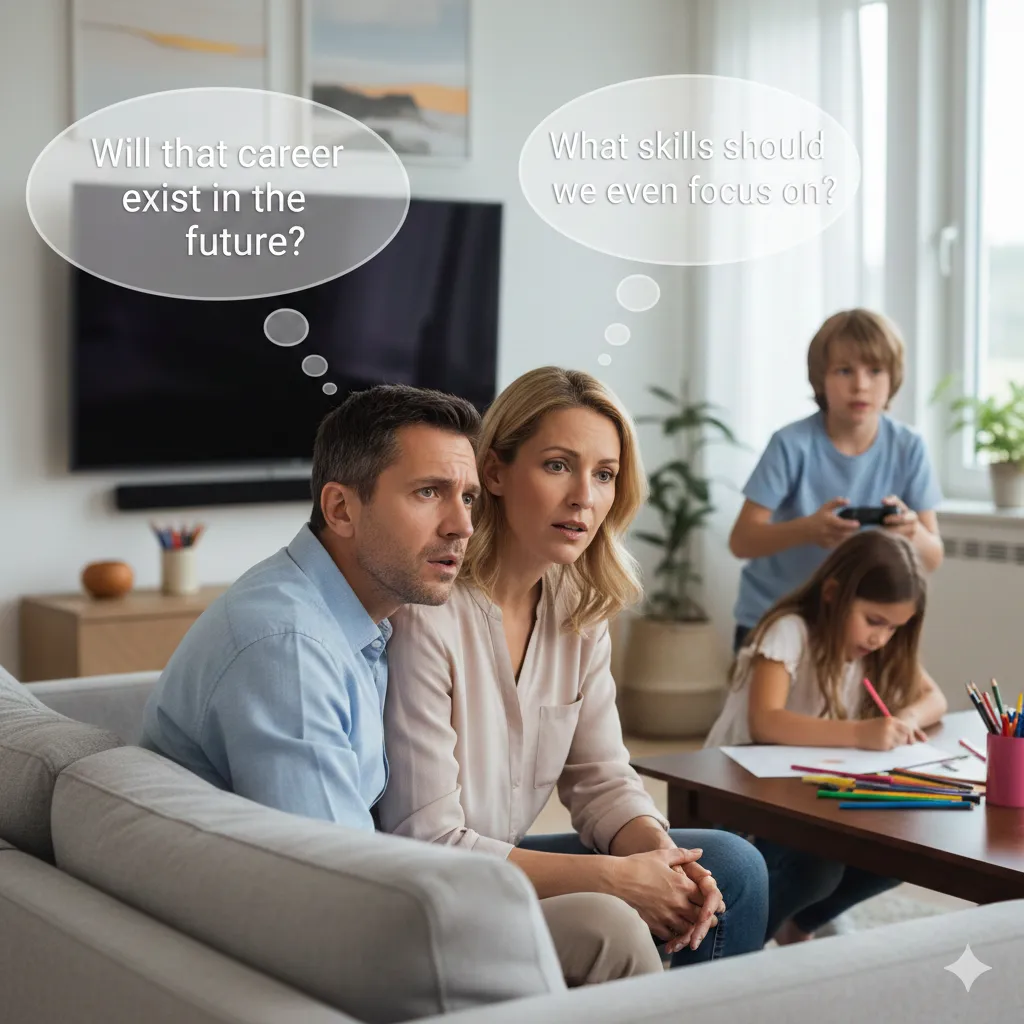
Fear that if she did not engineer the perfect path early enough, her child would fall behind in a world changing faster than any of us were prepared for.
Maybe you have felt that.
Late-night scrolling.
Headlines about AI replacing jobs.
Pressure to choose the “right” electives before middle school.
Here is the reality.
No one can accurately predict what careers will exist in 15 years. Not economists. Not tech founders. Not schools.
But neuroscience gives us something better than prediction.
It gives us capacity.
According to the World Economic Forum’s Future of Jobs reports, adaptability, complex problem-solving, and resilience consistently rank among the top skills employers want. Technical skills evolve. Human capacity compounds.
So I stopped obsessing over résumés.
I started focusing on three things instead.
Emotional Regulation Under Pressure
When a child is overwhelmed, the amygdala activates. Stress hormones rise. The prefrontal cortex becomes less efficient.
The prefrontal cortex is responsible for planning, reasoning, impulse control, and flexible thinking.
In simple terms, when a child is dysregulated, their thinking brain is offline.
You cannot build future skills on a hijacked nervous system.
With this ten-year-old, homework triggered threat. Not laziness. Not a lack of intelligence. Threat.
Instead of escalating consequences, we trained regulation.
We implemented a simple reset:
Slow exhale breathing. Inhale four seconds. Exhale six seconds.
Name the emotion. “I am frustrated because this feels hard.”
Define one micro-step. “Complete question one.”
Research on affect labeling shows that naming emotion reduces amygdala activation. When the nervous system settles, cognition returns.
Within weeks, homework resistance decreased. Not because he loved math. Because he could stay regulated long enough to think.
That is future-proofing.
Adaptability and Cognitive Flexibility
Rigid thinking says, “This is not how it was supposed to go.”
Flexible thinking says, “Okay. What now?”
Cognitive flexibility is an executive function skill strongly linked to academic success and long-term resilience.
You do not build it through lectures. You build it through exposure to manageable change.
We introduced small pivots:
Changing board game rules mid-play.
Cooking without a key ingredient.
Letting him lead small decisions with constraints.
At first he resisted.
Then he began asking a different question: “What are my options?”
That shift matters.
A 2023 McKinsey report projects continued growth in demand for social and emotional skills across industries. Adaptability is not a trend. It is durable.
You cannot predict the job market.
You can train a brain to tolerate change.
AI Fluency With Discernment
AI is not optional infrastructure. It is here.
But fluency is not the same as dependency.
Research from Stanford’s Human-Centered AI Institute shows adults often over-trust AI outputs when answers sound confident. Children will do the same unless we teach discernment.
So instead of banning tools or handing them over blindly, we practice three questions:
How do you know this is accurate?
What might be missing?
What would you cross-check?
We are not raising kids to compete with AI.
We are raising kids who can question it.
Judgment.
Ethics.
Discernment.
Those are harder to automate.
The shift for this mom was simple.
She stopped trying to design a career path.
She started building capacity.
Her son is still creative. Still occasionally resistant to worksheets. But he regulates faster. He pivots more easily. He asks better questions.
Those traits transfer anywhere.
Medicine.
Entrepreneurship.
Trades.
Careers that do not exist yet.
If you are losing sleep trying to predict your child’s job in 2045, pause.
The résumé is not the foundation.
The nervous system is.
The mindset is.
The thinking habits are.
If you want practical, science-backed ways to build these capacities at home without turning dinner into a lecture, that is exactly what we are doing in this week’s pop-up.
We are walking through clear, realistic ways to strengthen regulation, adaptability, and AI discernment in everyday life.
Details are below.
Stop trying to predict the title they’ll have.
Start building the capacity.
That is what actually lasts.
If you want practical ways to build these skills at home without turning dinner into a seminar, that is exactly what we are doing in Wednesday’s pop-up.
Thanks for reading Future-Ready Families! Subscribe for free to receive new posts and support my work.