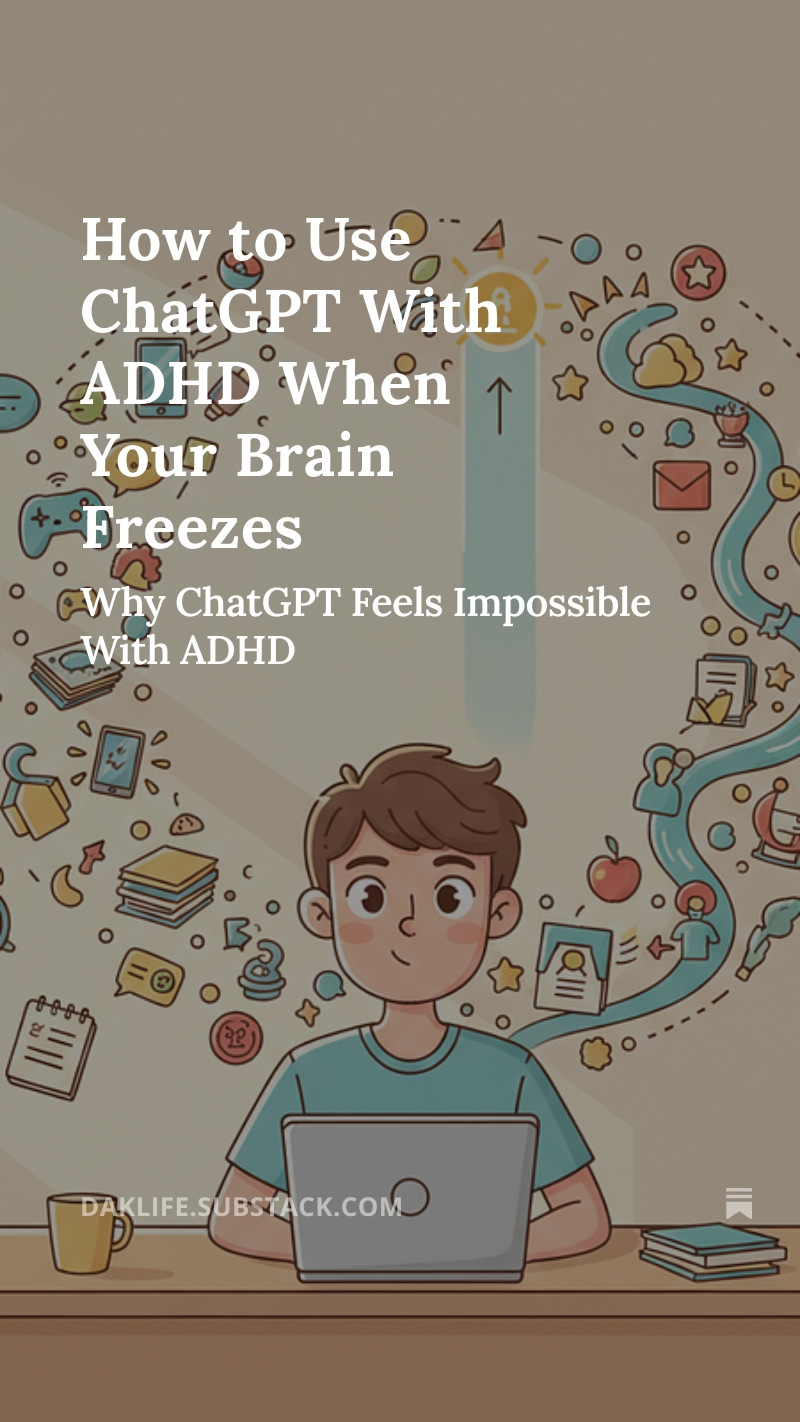
The ADHD-Friendly Way to Use AI When Focus Feels Impossible
You open ChatGPT with the best intentions. You stare at the blinking cursor. Your brain immediately goes blank, then somehow tries to think of everything at once. Five minutes later, you’re overwhelmed, mildly annoyed, and wondering if AI is just another tool that works for everyone except you. The problem isn’t your ADHD brain — it’s that most people were never taught how to talk to AI in a way that actually works with how your mind functions. And once you fix that part, everything changes.
And no, “just try harder” was never the solution.
Why AI Feels Extra Hard When Your Brain Works Differently
Here’s what neurotypical productivity advice gets wrong: it assumes everyone starts with a clear task, breaks it down logically, and executes in sequential steps. ADHD brains don’t work that way. You might have seventeen task fragments, three brilliant ideas, and zero sense of where to start — all happening simultaneously while you’re trying to remember if you already ate lunch.
Traditional AI prompting guides make this worse. They tell you to “be specific,” “provide context,” and “clearly state your goal.” Great advice if your brain naturally organizes information that way. Completely useless when your thoughts feel like a browser with 47 tabs open and you can’t remember which one is playing music.
Kismet fact: Research on ADHD and executive function shows that the real challenge isn’t lack of focus — it’s difficulty withselectivefocus. Your brain doesn’t struggle to pay attention; it struggles to filter which attention matters right now. That’s why vague, open-ended AI prompts feel paralyzing while structured ones feel like someone finally handed you a map.
(Running out of time? Read the quickADHD-friendly AI guide.
The Three-Part Framework That Actually Works
Forget everything you’ve been told about “perfect prompts.” Here’s what works when your brain needs guardrails:
1. Start with a brain dump, not a perfect prompt
Don’t try to organize your thoughts before talking to AI. Instead, treat your first message like you’re texting a friend who gets you:
“I need to send an email to my kid’s teacher about the homework situation, but I don’t want to sound like I’m making excuses or being that parent, but also I need them to understand what’s actually happening and I have like five different points I want to make, but they’re all jumbled.”
AI can work with this. It’s designed to find patterns in messy input. Your job isn’t to be clear — it’s to get started.
2. Ask AI to organize your chaos
Once you’ve dumped everything out, use this exact phrase: “Can you help me organize these thoughts into a clear structure?”
This is where AI becomes genuinely useful for ADHD brains. It takes your scattered input and creates the scaffolding your executive function struggles to build. You’re not asking it to read your mind — you’re asking it to be the external organizing system your brain needs.
3. Work in tiny chunks with clear next steps
Here’s the game-changer: never ask AI for the completely finished thing. Ask for one small piece, review it, then ask for the next piece.
Instead of: “Write me a professional email to my kid’s teacher.”
Try:“Based on what I just told you, what are the 3 main points I need to make in this email?”
Then:“Okay, can you write just the opening paragraph that explains why I’m reaching out?”
Then:“Now write the part about what I’ve noticed at home.”
Each step takes 30 seconds. Each step gives your brain a dopamine hit of progress. Each step keeps you from getting overwhelmed by the whole task.
The Prompts That Work When Your Brain Won’t
These aren’t fancy. They’re specifically designed for the moments when focus feels impossible:
When you can’t start:“I need to [task] but I’m stuck. Can you ask me 3 simple questions to help me get started?”
When you can’t decide:“Here are my options: [list them]. What questions should I ask myself to figure out which one makes sense right now?”
When you’re overwhelmed:“I have to [big task]. Can you break this into 3 tiny steps I can do in the next 10 minutes?”
When your thoughts are scattered:“I’m trying to figure out [topic], but my thoughts are all over the place. I’m going to dump everything I’m thinking and I need you to help me see the pattern.”
When you need accountability:“I need to [task] today, but I keep avoiding it. Can you help me figure out why I’m resisting and what would make it easier?”
Notice what these all have in common: they acknowledge where your brain actually is right now, not where productivity gurus think it should be.
What This Actually Looks Like in Real Life
Kayla, a mom in my AI Without the Panic program, used to avoid ChatGPT entirely. Too much pressure to get the prompt “right.” Now she uses it daily, but her approach looks nothing like the tutorials.
She opens it and types: “Kid meltdown this morning, need to email school, don’t know what to say, feeling defensive.”
AI responds with questions. She answers them as thoughts come. No pressure to be articulate. Then she asks it to draft something. She edits out the overly formal parts. Sends it. Done.
Total time: 8 minutes. Number of times she had to “focus really hard”: zero.
That’s the difference between forcing your brain into someone else’s system and using tools that actually work with how you think.
The Permission You Didn’t Know You Needed
You don’t have to use AI the “right” way. You don’t have to write perfect prompts. You don’t have to organize your thoughts first.
You can be messy. You can start mid-thought. You can change direction three times. You can ask it to redo something because you forgot to mention the most important part.
AI doesn’t judge your process. It doesn’t care if you take the scenic route. It just responds to what you give it.
The only rule that matters: keep the barrier to entry as low as possible. One sentence that captures where your brain is right now beats ten minutes of staring at a blank screen trying to formulate the perfect prompt.
Your Next Smallest Step
Don’t try to implement everything at once. Pick literally one thing:
Open ChatGPT rightnow and type one incomplete thought about something you’re avoiding. That’s it. See what happens when you let AI be the organizing force instead of your own executive function.
Or try this:next time you’re stuck on a task, tell AI, “I’m stuck on [task], and my brain won’t cooperate. What’s one tiny thing I could do right now?”
The breakthrough isn’t learning to use AI perfectly. It’s learning that your scattered, non-linear, messy-thought-process brain can use AI exactly as it is — and maybe even has advantages you haven’t discovered yet.
Because when someone finally hands you a tool that works with your brain instead of against it, that’s when everything clicks.
Get the10 ADHD-friendly AI prompts. Copy. Paste. Start messy.